Press coverage of the PNAS Nexus paper
In a paper published today in PNAS Nexus, the DAWN team shows that the claim that irrigated agriculture produces 40% of all food and withdraws 70% of all freshwater has circulated for fifty years in science and policy without much empirical support. This result implies that a central narrative in global food and water policy has been built on largely unsubstantiated figures. If the 40%-and-70% claims are unreliable, current assessments of irrigation’s role in food production, water demand and sustainability may be miscalibrated. Policies, models and research relying on these numbers may need to be re-evaluated and future work will require more rigorous, transparent evidence to guide decisions about global agricultural water use.
The study has relied on network citation analsis and uncertainty and sensitivity analysis, and has been given press coverage in Scienmag and Phys.org.
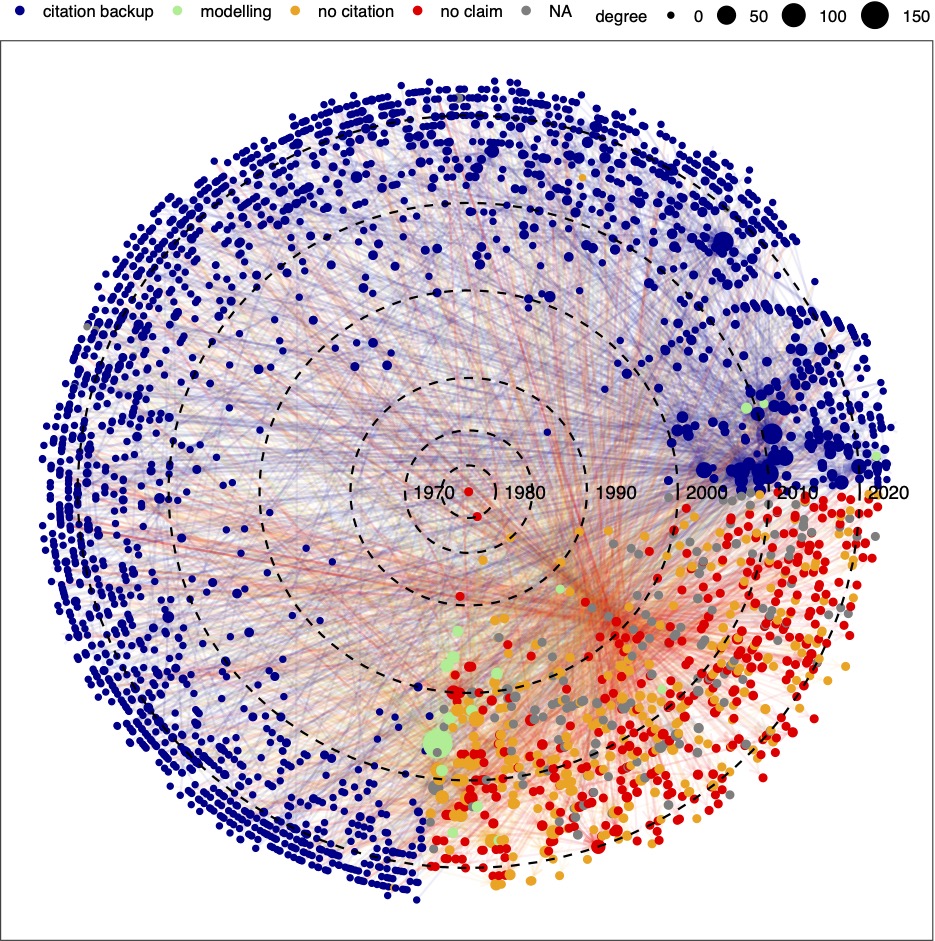
Citation network of the belief that "irrigated agriculture withdraws 70% of all freshwater resources", formed by 2,925 documents published between 1970 and 2020. Nodes are documents making this claim and edges are citation paths. The size of the nodes (documents) correspond to their degree; that is, the number of incoming edges (citations). Blue nodes ("citation backup") denote documents that make the claim and support the claim with a citation. Green nodes (“modelling”) represent documents that produce original data supporting the claim through a modelling or statistical exercise. Orange nodes ("no citation") are documents that make the claim but do not produce original data nor cite any study to support the claim. Red nodes ("no claim") are documents that are cited to support the claim but do not actually make the claim. Grey nodes ("NA") represent documents that are cited as making the claim but that we have been unable to access. Only c. 1.5% of the documents cited to support the 70% number provide original data and 60-80% of all citation paths lead to documents without data (orange nodes) or to dead-ends (red nodes); that is, to documents that do not even contain the numbers.

